
These are five articles that we think you should read, but probably don’t have the time to, or because they’re behind a paywall. The first part of each section is a summary of the critical points in each article, followed by a small amount of commentary either filing in the gaps, or extending the idea. The key concepts this round are; the permanent damage being done to the security architecture in the Middle east, why the oil market is behaving the way it is, and the failure of American coercive power.
The End of the Axis of Abraham: The Arab Gulf and Israel Have Different Visions for a New Middle East
H. A. Hellyer, May 4, 2026
Summary
Dr Hellyer writes here about the damage the Iran conflict has done to the US built order in the Middle East. The signal that the Gulf States, Turkey and the other Middle Eastern states are getting from the Iran War is that the Abraham Accords are about Israeli dominance in the region. While the US were clear on this this was not how it was viewed in the Gulf. Hellyer goes on to argue that the war is making clear to the Gulf States, that by being part of the accords, and being aligned with the United States, they are a target. He reports that the Gulf states are reacting in different ways. The UAE are deepening ties with Israel and the US, particularly militarily. Whereas Saudi Arabia, Qatar, and Kuwait are moving to diversify their security architecture; specifically with Turkey, South Korea, Japan, and the United Kingdom; and moving towards a more transactional relationship with the US.
Crazy Ivan
From the Arab side the Abraham accords were about normalisation, from the American and Israeli side. Hellyer mentions the Pakistan and Saudi axis briefly but this is is the critical thing to understand, this is not about Saudi Arabia attempting to retaining independence it is about Saudi Arabia maintaining its position as a regional power. The Iran war has accelerated a bunch of trends, be that the IRGC’s power base in Iran, or the spectre of US military vulnerability, but particularly a realignment of the Middle East. Dr Hellyer also touches on Israeli ambition, the Abraham accords being a representation of their position in the region, perhaps it is for this reason that the Abraham Accords were added to the latest failed round of negotiations. Either as a poison pill to ensure the war continues, or to cement Israel’s position in the ascendency as primus inter pares in the region.
The timing of the impending crude crisis
Robin Brooks and Ben Harris, May 22, 2026
Summary
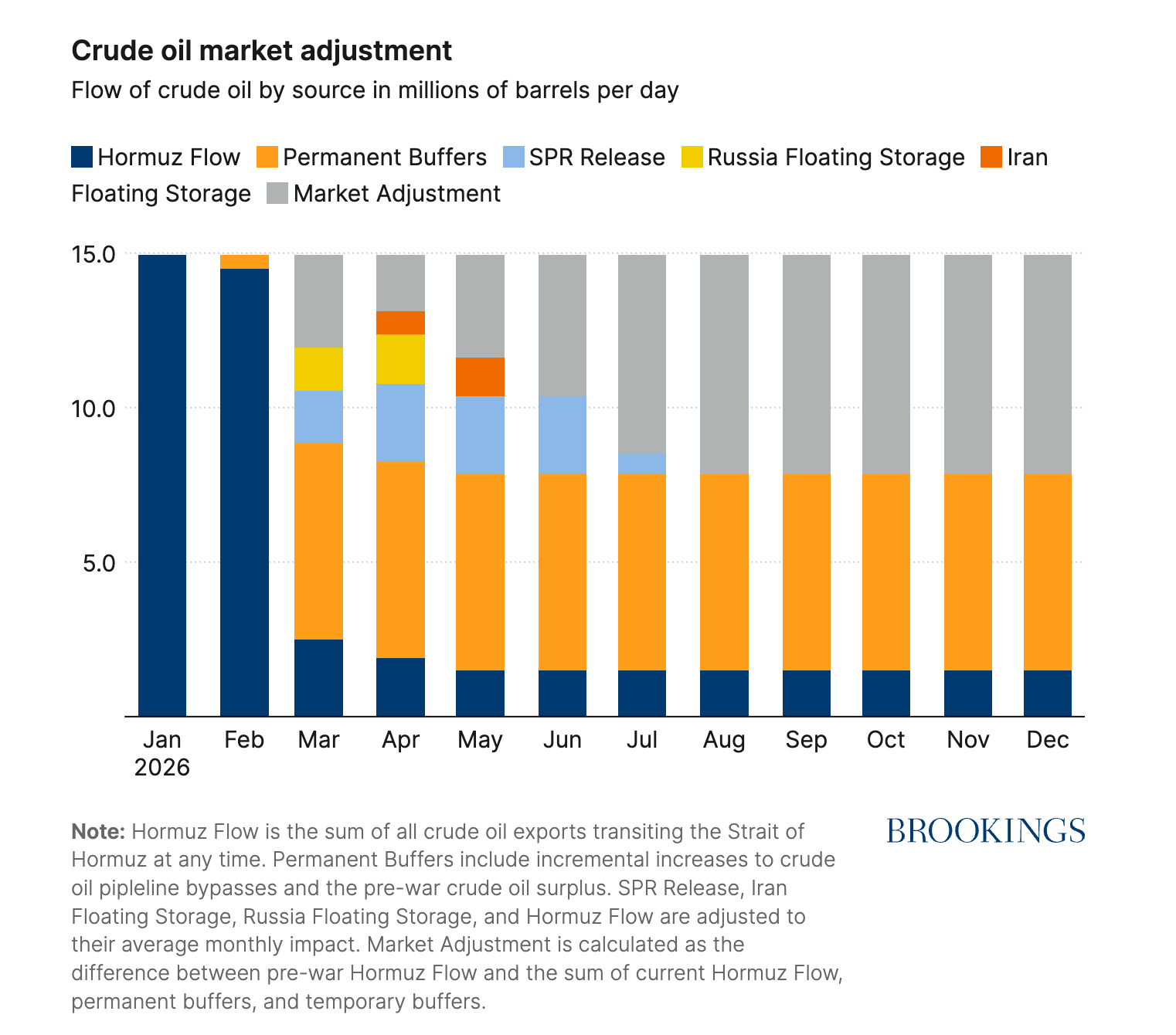
Brooks and Harris question why the supply side shock of oil has not been reflected in prices, where benchmarks remain below 2022 highs in the aftermath of the Russian invasion of Ukraine. The market is being propped up by a combination of temporary buffers, structural adjustments and an optimistic expectation for the duration of the crisis. Brooks and Harris lay out each of these factors. The permanent changes are the Saudi and Emirati pipeline bypasses worth 5.7mb/d; and a global crude surplus driven by American and Latin American oil capacity rising, especially Guyana and Brazil. One temporary factor is the 400m barrel oil release from government stockpiles, adding up to 2.5mb/d over a four month period, but this has a time limit, and will need to be replenished. Another temporary factor is Russian and Iranian oil in floating storage which sanctions waivers allowed Asian markets to purchase, however this also is finite, and will get depleted. The authors then calculate how long this can last, which is essentially by July the temporary factors will be exhausted, and then we are reliant on the structural alterations to manage oil prices, putting them somewhere between $120 and $150 per barrel.
Crazy Ivan
This is the first really clear answer to the confusion many have had as to why the oil markets have been less volatile than expected. The authors don’t delve into the market manipulation effects of the White House’s announcements of peace, nor do they talk about the reciprocal effect that oil prices are having on the US prosecution of the war. With that said, they are correct on the fact that the oil market was able to temporarily adjust to the crisis very efficiently, and that the market has been reacting to temporary measures as if they are permanent. The next thing to think about is what the price of oil is going to look like post conflict, with the reserves needing to be refilled, and with the geopolitical risk premiums built in, as well as a diminished volume through Hormuz due to the Iranian toll.
Iran and the Forever War Trap: In Trying to Avoid a Quagmire, America Found a Dead End
Lawrence D. Freedman, May 27, 2026
Summary
Professor Freedman in this article argues that the current divide between the US and Iran in their negotiating position suggests that this is not over by a long shot. The American desire to avoid a Quagmire in the vein of Vietnam means they are limited to drones and air power, so their military force can only be coercive rather than decisive. Great powers often assume that overwhelming military force will win quickly. Freedman goes on to point out that the fact that the war is existential for Iran and not for America does not bode well for negotiations. Great military power tempts its wielders, with high tempo complex operations with a swift end date, but this has not achieved its desired political results. The core of this article is pointing out that tactical success, and brilliance is not a guarantee of strategic success.
Crazy Ivan
This article emphasises the fact that the United States are not winning this war, despite every tactical advantage. The application of overwhelming military power is not enough if you haven’t read your Clausewitz. The United States are unaware of where the center of gravity is for this conflict, and by that we mean, where the power and movement of Iranian force is focused. The main concept Freedman explores is the idea that the United States cannot win this war in the way they wish with the tools they are currently using.
Could Russia Follow the “Hormuz Playbook” in the Baltic and Black Seas?
Miro Sedlák, May 8, 2026
Summary
Miro Sedlak makes the key observation in this article that the thing actually stopping ships transiting the Strait of Hormuz is a lack insurance rather than a guarantee of being sunk. He clarifies something that often gets lost in the reportage, in that that strait is being ‘priced’ shut. He then uses the model of an implied threat to demonstrate that Russia could easily use this as an extension of their hybrid warfare into the naval dimension. Sedlak presents two case studies, the Danish Straits, and the Turkish Straits, and breaks down how the Russians could trigger an insurance cascade paralysing the energy import architecture of Northern Europe. He goes on to suggest several solutions, primarily about providing government or NATO backed insurance for strategic cargoes. Overall a concerning piece detailing how the Iranian asymmetric model might spread.
Crazy Ivan
There are a couple of issues here, primarily that the United States did try the reinsurance model with Hormuz, but ship captains were reluctant to run the gauntlet during a high kinetic moment of the war. This, in fact, backs up Sedlak’s argument that this could easily proliferate. Russia have demonstrated a willingness to act brazenly, but still short of conflict, with the west. However the strategic value to Russia of shutting the Danish straits down is outweighed by the likely Western response. Shutting down the Black Sea however would be much easier for Russia, and would deal a blow to global grain supplies. Rather than causing financial disruption to Europe this would create a global food crisis, compounded by the incoming fertiliser shortages due to Hormuz. Strategically this could put pressure on Ukraine to make a deal. Ultimately Sedlak does show the viability of Iran’s strategy as an exportable model.
The Cost of the Iran War for the United States: A Strategic Blunder in Five Dimensions
Tahir Azad, April 27 2026
Summary
Tahir Azad summarises the five different areas where the US have underperformed during the Iran War and lays out the consequences of these failures very clearly.
Military: The weapons burn rate has been incredibly high; the US could have maintained the original operational tempo for 6 weeks maximum. The cost asymmetry is also skewed agains the US, with 4 F-15s, among others, destroyed, as well as 13 service members dead. This has damaged the US’ credibility and given a road map to resisting their military power.
Financial: The Pentagon initially briefed that the first 6 days cost $11.3bn, excluding munitions stockpile replenishment, there are estimates that at its peak it cost 2b per day, and the total could be 1t. It also impacted the US’ debt situation with the 1.5t budget, the single largest defence expansion since the Second World War.
Regional: The war has exposed the ineffectiveness of the American security umbrella, has damaged relations with the Gulf states by hurting their economies, and disrupted energy supplies globally.
Diplomatic: NATO and the EU were not consulted on the decision to go to war, nor warned. Spain closed its airspace to the US, France blocked US and Israeli weapon flights, even the UK initially refused to allow UK base usage. US in response have delayed Foreign Military Sales to rebuild own arsenal, withdrawn from exercises, and to escalate rhetorically. These are damaged relationships as no NATO power will be able or willing to trust the US in the short or the long run.
Global: This war has handed the strategic initiative to China, as well as taking resources and focus away from the Ukraine war benefitting Russia. This is deleterious to the United States’ reputation, and ability to leverage issues on a global stage.
Crazy Ivan
Aside from having the cascade of failures laid out cleanly, Tahir Azad places the correct amount of emphasis on what are the more catastrophic failures, namely the diplomatic and regional damage. Robert Kagan (of all people) on the 28th of May spoke about how this war has done irreparable damage to the US reputation. We think this is correct, as this will embolden US enemies to take more provocative actions, and essentially hamper the ability of America to build coalitions to tackle problems. An example of this is the Abraham Accords, which were holding before this war, and are now in pieces; President Trump is attempting to make signing them a pre requisite for Gulf states in his peace deal, and the only outcome of that will be a divergence between the US & Israel and the Arab nations.
This is really insightful analysis. Thanks for the information.