
One of the selling points of President Trump’s victorious effort to reclaim the Presidency was his promise to end ‘Forever Wars’ in the Middle East. These campaigns that began with one war aim, and ended with the failure of several, leaving nothing behind but a worse regime, and American dead littered across the desert. The Iran War is not at risk of becoming a ‘Forever War’ rather it already is one. Last night the War threatened to reignite as Israel and Iran traded ballistic missiles, this shows how this conflict is fated to keep simmering. It will not end when the American Navy lifts it’s blockade, it will not end when there is a ‘memorandum of understanding’, and it will not end when President Trump declares victory on network television. The fundamental problem is that the United States cannot leave this regime in power, but there is no negotiation that removes them from power. So the Iranians will continue to agitate and wield their Hormuz tollbooth and uranium stockpile as a sword and shield. While the Americans hold their blockade and threaten to unleash the full force of the most powerful military in history. And neither side will move because of a simple fact; both sides are structurally locked into this conflict.
Irreconcilable Differences
In the last round of negotiations, the Iranians more clearly tied the prospects for a ceasefire to the cessation of the Israeli campaign in Lebanon. This will torpedo the ceasefire at two points below the waterline. The first is that it relies on the IDF demonstrating restraint in a time and place where they have no tactical reason to do so. With their strikes on Beirut on Sunday 7 June, and Iran’s retaliation, this has in fact already put the war at risk of re-escalation. The center of gravity of this war has always been pulled towards Jerusalem, and as has been the case for this entire campaign, the war aims of the Israelis are unaffected by US strategic concerns and difficulties. The second, and more important point, is that this is a maximalist demand being made in response to the maximalist demands of the United States. If the IRGC believed it was negotiating from a position of weakness it would not demand that its proxy forces fall under a security umbrella guaranteed by a deal between Tehran and Washington. This tells us that the Iranians are willing to make the war kinetic again. They clearly believe that the strategic calculus of US airstrikes versus a closed Strait of Hormuz and drone attacks on the Gulf favours them.
The other problem is that in response to this the United States are being similarly maximalist. Both sides are making demands that the other politically can’t accept. At the same time, the US are demonstrating limited appetite for a re-escalation of the conflict. This was made abundantly clear by the bipartisan rebuke the other night, restraining the War Powers of the President. However the US can still retaliate against Iranian force and will unleash its considerable firepower if and when it is pushed. The issue is that in an effort to avoid a ‘forever war’ President Trump and his team adopted the ‘compellence’ framework where the threat of force is balanced by an acceptable offramp. It seems the Americans are applying only the first half of this particular strategy. It also demonstrates a misunderstanding at the heart of American Wars in the Middle East going back a quarter of a century. You cannot wage a limited war against an enemy for whom the war is existential. This is the same issue that the US ran into in Afghanistan and Iraq, and they have managed to do it without a single soldier having to set foot in Tehran. The elites within the IRGC directing the Iranian war effort have interests that will only survive as long as this regime does. So any negotiation will have to begin and end with the survival of the IRGC Praetorian regime.
The Fantasy of Regime Change
The closest parallel to where we are now is not, as you would expect, the Wars in Iraq or Afghanistan, but rather a Cold War episode, the Bay of Pigs fiasco. In April 1961, buoyed by support among Cuban exiles, and surrounded by over-optimistic advisors, President Kennedy okayed an operation inserting a small force into Cuba. The logic was simple, a US operation would coalesce popular discontent at the regime into a rebellion, and this would lead them, inexorably, to victory. What ensued was around 1500 Cuban exiles dead or captured and a regime that is still in place 65 years later. Where the parallel fails is that President Kennedy realized immediately that the operation was doomed, and withdrew support. That, and Cuba doesn’t sit on top of a global chokepoint. But whereas Fidel ended up threatening to point nukes at Florida, the Iranians have ended up pointing one at the financial markets. There is a a fundamental misunderstanding of how regime change happens, it is rarely driven by popular discontent, but rather it is the result of ‘elite fracture’. The same optimism that created the conditions for failure in 1961 is back in action in 2026.
There are a number of commentators arguing that the blockade is working, and by many metrics it is; causing immense damage to the Iranian economy. The rial is sitting at 1,850,000 to the dollar, inflation is above 40%, food price inflation is above 70%, the CIA have assessed that Iran can last 3-4 months before there is severe economic hardship. The problem is that the average Iranian being unable to buy bread is not what brings down regimes, but rather when enough people with power no longer feel the regimes survival will serve their interests. With ‘liberals’ like Pezeshkian and others in his faction trying to open broader negotiations and curtail the power of the IRGC during the early phases of this war, we saw some fracture. But a combination of US kinetic force and pressure has led to the consolidation of the IRGC in the upper echelons of the Iranian regime. Another problem is that the macroeconomic pressure prior to the war was generating protests, but not an organized opposition. The protests represented exhaustion rather than revolution. The expectations of change remained almost entirely within the exile community, and the American government. This contributed to the ‘short war’ optimism.
The other issue with this model of pressurized regime change is that it misunderstands the nature of military-adjacent regimes. The decisive variable is the security apparatus and whether or not it can function. In the West we tend to think of civil-military relations as a dual track process, the army stays out of politics, however in many places there is a different model. Alfred Stepan’s framework on civil-military relations tells us that in military adjacent states, legitimacy is derived from the loyalty of the security apparatus. What has happened is that the Iran War has altered the regime from military adjacent, to the Praetorian, military run regime that now exists. Rather than fracturing the relationship between the security apparatus and the regime, the war has consolidated it. And rather than getting a short war creating a popular revolution, the US has a forever war without ever having to invade.
Blockade Runners
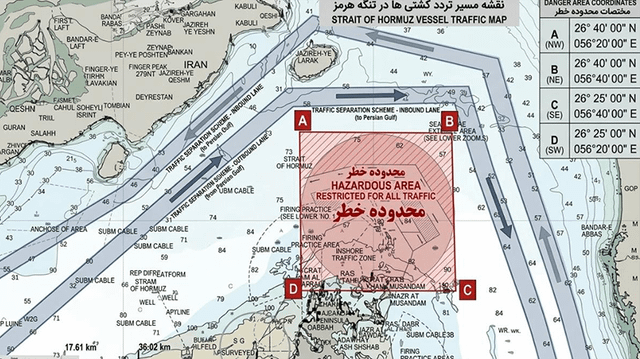
Escalation might be a better path to victory, but it would be politically and militarily costly, and is just as likely to bog the US down in a ground war in the Middle East. Accepting the Iranian terms would strengthen the IRGC regime, as well as being a humiliation on a global scale. The upside is that the blockade’s logic is sound, the downside is that it will take months if not longer to see genuine results, and with the oil market perched on the precipice, the midterms approaching, and a bipartisan revolt brewing, the US simply do not have that time, and Iran does. The blockade is simultaneously being undermined from outside by two factors. The first is that Iran’s ability to evade the blockade has strengthened, as both Iranian and non-Iranian cargoes are being transited ‘dark’ through the strait of Hormuz. This is dangerous for the ships, but equally for US interdiction, as they are unaware of the origin of these dark ships until they have been stopped. This means they could stop a tanker headed to an ally like South Korea while an Iranian tanker slips through. What is important though is that rather than being an Iranian strategy, this is a signal that the market is becoming increasingly desperate to get oil out of the Gulf, and that is a worrying marker for the US. The second is the ‘Marinakis Problem’, shipping magnate (and Olympiacos owner) Evangelos Marinakis has publicly indicated his willingness to pay the Iranian toll to move cargoes through the Strait of Hormuz. While he is (as usual) outspoken, he is not alone, frustration has been building with the double blockade. The issue arises for the US as every toll paid replenishes Iran’s economy and normalises the Iranian toll; it becomes structurally embedded in the global economy. What this normalisation means is that the longer this conflict drags on in Limbo, the stronger Iran’s position gets.
The China Factor
The time limiting factor here is the oil market, and why it is remaining so sanguine in the face of the geopolitical calamity playing out in the Persian Gulf. There are a number of possible reasons, one is the belief that the Carter Doctrine will be re-established and that the US will return to being the guarantor of the freedom of passage, somehow. The other, more logical reason is that there has been ‘demand destruction’ combined with strategic oil releases, most notably by China. China’s ability to replace oil with coal for energy generation, and minimize it’s footprint in the market has been the main contributor to keeping oil prices at a stable level. This, partially, could be because China wishes to portray itself as a stable and serious partner, and a guarantor of energy security in a way that the Americans are not. However, the end result for the market is that at any point, China could end this artificial suppression of oil prices and turn the screw on the US position. The timer the US are working to could very easily get shorter than the strategists, the commentators, and the economists believe.
Conclusion
This is not a war that ends in any meaningful way, its impact will drag on for years, reflected in elevated energy costs, a permanent insurance premium, and a US Navy that cannot leave. The question is what the geopolitical realities of the world are when this conflict has become endemic, with the Strait either contested or tolled, and with a consolidated Praetorian regime. A regime that does not believe itself to be beaten and will continue to make maximalist demands and drag on this war. For the US the only strategy remaining is to sit and wait it out, in this new form of grey forever war. Because this is a war waged not by soldiers but by spreadsheets, a war with no battles, no victors, only casualties. Be they American soldiers killed, Iranian civilians bombed, or those who will die due to oil and food shortages in the coming months.
Great read.