
Armoured personnel carriers rumble down empty streets at night, past shuttered up shops and burned out buildings; heavily armed gendarmes struggle to control an openly revolting population. This was Paris last week during heavy rioting, but this could just as easily refer to the era of the Algerian War. Over the course of 1956 the situation in Algiers spun out of control with protests and riots turning into bombings and all-out urban warfare. French history gives us a parallel for what is slowly turning into the Battle of Paris. In Algiers the battle was fought between a revolutionary group and a colonial government, in Paris it is between a broad coalition of movements and a centrist administration. Though in terms of grievance and background the revolting groups could not be further apart; the tactics and strategies of the gendarmes in Paris this week would be instantly recognisable to veterans of Massu’s wars.
The Protests
On the 17th of October around 110k people marched through Paris, amongst a total of 550k nationwide. It has emerged that French Intelligence had expected c.50k in Paris and another 100k across the country, this intelligence failure is just one of the reasons these protests have escalated the way they have. So far there have been close to 2,400 arrests nationwide with 1000 police, gendarmes and firefighters injured. There has been significant economic damage with 3000 shops looted and the historically important Limoges town hall burned to the ground. In response the French government have introduced localised curfews through prefects; Prime Minister Lecornu has deliberately held back from declaring a state of emergency but the government otherwise appears to be taking a tough line on the rioters. However, in terms of de-escalation they have offered no olive branches or searched for a way to placate the protesters. The protesters are formed of a broad coalition of students and people frustrated with the cost of living. It began in mid September as a protest over teaching shortages, overcrowded classrooms and crumbling buildings; it was followed by strikes by the public sector unions against the 2027 budget. Ultimately the main issue is that the budget which raises defence spending from €57bn to €63.4bn, has only given education a marginal increase and has frozen public sector pay.
Algerian Echoes
France’s response to this kind of grievance was forged in its colonial wars, counter-insurgency (COIN) being an intellectual lineage that is particularly French thanks to their experiences in Indochina and Algeria. The concept of ‘guerre révolutionnaire’ is one we should be cognisant of as we look at the administration’s response to these protests. Roger Trinquier fought in Indochina and was then in charge of organising Algiers to be more malleable by building a system to register and control the city’s population. He argued that modern warfare is about fighting clandestine organisations hidden amongst the people. This echoes Maoist guerrilla doctrine but with an urban flavour that emerged from the brutality of the Battle of Algiers, and when it comes to the current protests refers to the idea of an internal enemy within the protesters. There is also Charles Lacheroy who conceptualised the parallel hierarchies, or governance, that successful insurgencies build to capture the population before fighting begins. This is the idea that the battlefield is the psyche of the population, essentially the minds in ‘hearts and minds’. But it also creates the problem that these structures can exist anywhere and thus so can the enemy. The French COIN mentality is one preoccupied with an internal enemy, and it is this inherited reflex that is surfacing now. There is a bitter irony in the fact that these doctrines were developed against France’s colonial subjects, and are now being deployed against their grandchildren in the banlieues.
Galula and Colonial law
Perhaps the most important of the French COIN philosophers is David Galula; born in the Tunisian French Protectorate to Jewish parents in 1919. He was an officer in the French Army until forced out by Vichy France’s anti-semitic laws, he then joined the Free French and had a solid career, most notably as an observer of the Chinese Civil War, and then as company commander in Kabylia, a mountainous Berber region of Algeria. His most famous work, the creatively titled Counterinsurgency Warfare: Theory and Practice was largely ignored for four decades until it was picked up by General Petraeus during the Iraq War. The formula Galula gives us is that COIN is 20% military action and 80% political action; these protests are not a full scale insurgency but his calculus is applicable. He also discusses the preconditions for an insurgency as being a strong cause and a weak administration. He also named several theoretical laws, the fourth of which is that COIN demands vastness of means. In practice the reason why COIN failed in Algeria is that the cause was independence, and the political action offered by De Gaulle’s government were merely buy offs; the efficacy of the gendarmerie and the military superiority of the French Army were irrelevant in the face of that national desire. On the 3rd of October 1958 De Gaulle attempted to defuse the Algerian War with the Constantine plan; land redistribution, investment, and expanded rights for Algerian muslims. It failed. The Évian accords granting Algeria an independence referendum was the only act available to France that could end the war. The Constantine plan was the 80% that Galula refers to but the French did not understand the level of grievance. The legacy of Algeria has reared its head in the current wave of protests beyond COIN theory. Bruno Retailleau, a presidential candidate next year, has called for the invocation of the 1955 law. This is France’s state of emergency law, it creates an emergency for 12 days and gives sweeping powers to Prefects to ban gatherings and order house arrests. It was created in response to coordinated attacks by the FLN kicking off the Algerian war, and rather than handing control to the military this law created the circumstances for ‘extraordinary’ policing. It has been used before, during banlieue riots in 2005, and after the Bataclan terror attacks (after which several of its powers were signed into regular law). Lecornu has held off so far, but the capacity for the government to escalate within Galula’s 20% is a signature away.
The Gendarmes and COIN
The issue lies with French paramilitary doctrine, its strategy for policing comes directly from Algeria and the particular issues of that era. The gendarmerie is a military force, and to a degree the French police, in line with Trinquier and Lacheroy, react as if there is an insurgency. The intelligence failures that led to the gendarmerie expecting fewer protestors is partially responsible for the aggression of the policing response; a state that cannot see its enemy clearly treats them all like insurgents. The public order doctrine of 2020 created fast-moving units designed to make rapid arrests within violent protests, in COIN terms, separating the insurgent from the population. While this isn’t an insurgency, the lines between militarised policing and true COIN are blurry. French riot police use the GM2L tear gas grenade, classified as a weapon of war. A separate grenade maimed a student in Lens on the 5th of October. When it comes to counterinsurgency style military tactics, the French gendarmerie are not playing around. However, the political 80% is the ballgame, and the issue with increasingly militarised policing is that it does not resolve the underlying tensions. While the Constantine plan was a failed buy off in Algeria, the French government has successfully bought its way out of trouble in the past. The Gilets Jaunes protests in 2018 occurred over a rise in fuel tax, and Macron was able to defuse it for the most part by conceding €10.3bn of measures which raised the French budget deficit to 3.2% of GDP. In 1958 the cause was ideological, and in 2018 it was material. As today the cause is mostly material, however there is one massive problem that has turned these protests into a two-front war for the French government; in 2018 the 10 year bond yield was under 1%, in October 2026 it is at 4.96%.
Bonds, French Bonds
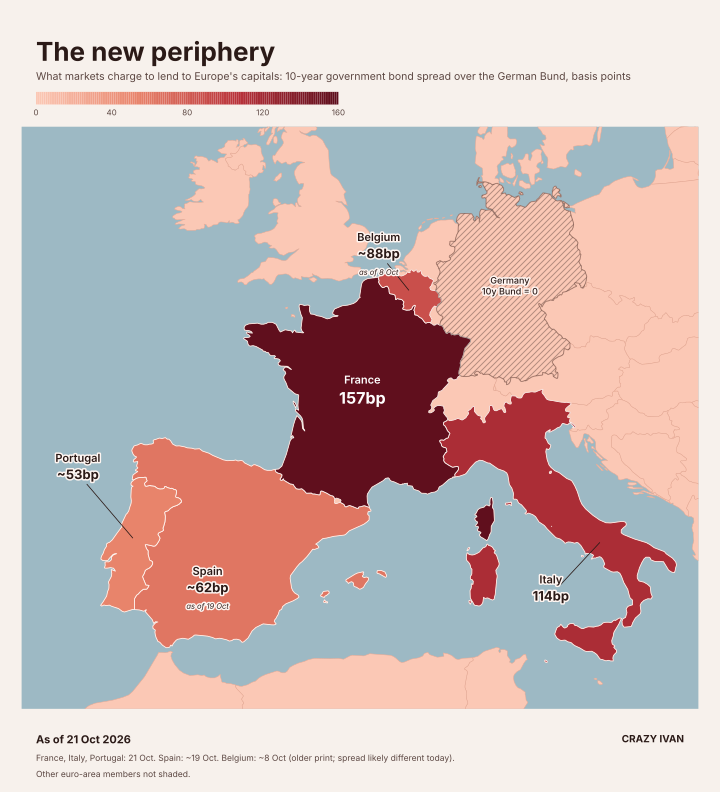
The French government are at war in many ways with two adversaries, the straightforward front is the clashes between paramilitary forces and protesters; the less obvious front is between the Elysee Palace and the bond market. The 10 Year French government bond (OAT) yield breached 5% in early October and is hovering around 4.9%, this is the highest level since 2002. The OAT-Bund spread, which shows us how much riskier the market prices French bonds compared to German bonds is at 152 basis points; essentially French bonds offer a 1.52% higher yield than the Bund. This tells us two things, first that French borrowing costs are sky high and this will increase the debt-to-GDP ratio, it also tells us that this is not a Eurozone crisis, but rather a consequence of high French debt, which is at 117.6% of GDP. The commonality between every faction within the protestors is a lack of money being directed to their particular cause; and an interesting statistic is that the education budget is smaller than the amount being paid to service French debt. The massive problem is that France cannot set its own monetary policy to bring down borrowing costs or pay down its debt, those decisions are made in Frankfurt.
Le Périphérique
During their colonial era Paris was the centre of a vast empire, the metropole which dictated laws, security and finance to the imperial periphery. In 2026 Paris is the periphery and Frankfurt is the metropole. The Eurozone has many weaknesses, primarily that it removes a nations financial toolkit for getting out of problem. Joseph Stiglitz summed it up well in describing ‘internal devaluation’; which is essentially national suffering until an economy becomes competitive again. This is where France is, they cannot cut interest rates because they are controlled by the ECB, they can’t devalue the currency, so the adjustment has to come through budget reductions; this creates Galula’s cause. To Frankfurt, the French government is the insurgent, trapped and chasing a cause and a deal that will not arrive; and to the street it is the oppressor unable to make a deal that will end the protests. The French have no capacity to even attempt a revival of the Constantine plan as they have no control over their own monetary policy; and the financial constraints that created their causes are a direct result of the Eurozone. This is not saying that the French economy is not one of the largest and most important in the EU but rather that they have ceded aspects of their decision making. The dual role of the French government, as periphery to Frankfurt and as the metropole to the protestors flooding the streets traps them in this two front war, where to win one is to lose the other.
Losers and Losers
The ECB do have a mechanism to rescue France where they can buy a nations bonds (bringing the yield down) if there yields are rising in a ‘disorderly’ way. France’s recent fiscal discipline means that they technically qualify; however Frankfurt is electing not to act thus far, as its mandate is primarily to manage inflation and the energy crisis emanating from the Iran War is a greater threat to the Euro than French instability. So France are truly on their own. To win the ‘war’ with the bond market, France will have to find €50bn in saving that will come from internal devaluation; this will only create greater cause for the protestors. This French government cannot win the war with the street, the likeliest outcome will be a change in regime, be that simply a victory for the populist right in April or a larger more consequential crisis that leads to a Sixth French Republic. The issue is that this is a financial crisis and as in 2008 someone may be allowed to fail to prove a point with France as Lehman Bros. being sacrificed to the populist right in the name of fiscal discipline.
Contagion
France hasn’t balanced a budget since 1973, there is little reason to believe that there is going to be a massive reversal in the level of French debt, and there are structural reasons for protestors to be frustrated with their own government as well as the EU. Street protests have already broken out in Milan, as well as student movements emerge in Belgium and Greece. The Italian Government Bond-Bund spread is at 114 basis points, Belgium-Bund is at 88. Combined with high debt, Belgium at 109.1% of GDP; this creates the same conditions as we are seeing in France, and while the Belgian and Italian populations don’t have the same revolutionary streak as found in the Gallic soul, make no mistake this can and will spread. Returning to counter-insurgency theory, we’ve noted the different causes held amongst the coalition forming the protests, but what is the equivalent of the Évian Accords for this group? The upcoming election is likely to sway France to the populist movements of Le Pen’s Rassemblement National, or Mélenchon’s La France Insoumise. Both have strategies to deal with the bond market issues. Le Pen has promised €140bn in savings within 5 years, and Mélenchon wants the ECB to effectively cancel the French debt it holds. Neither of these candidates has openly argued for leaving the Euro in this election cycle but both are campaigning on a EU-sceptic platform. So the independence France’s protestors are searching for may be found in populism. This is a French problem, but the structural conditions for it to spread exist, and then Europe could find itself facing immense political fragmentation.
Really great analysis. Thanks, also, for educating on the link between the gendarmerie and Algerian military strategy.
I wonder if you have a “representative” spread for the UK? My hypothesis is we’re experiencing the same thing in the UK, but far less likely to take to the streets à la français.