
On October 25th Brazil will go to the polls to determine the trajectory of its country. The choice is between the populist challenger Flávio Bolsonaro, and the leftist incumbent Luiz Inácio Lula da Silva. With Flávio Bolsonaro leading after the first round, it seems that the pro-America security agenda of the challenger will prevail. More than most elections, this will not only determine the direction of a country but also push the transition of an entire continent. Latin America is in transition, torn between its regional hegemon, the United States of America, and its main trading partner, the People’s Republic of China.
The Protectorate
The conversion of Venezuela from rogue state into American protectorate has been the main story of Latin America in 2026. The United States has breathed new life into the old United Fruit playbook. However, where once nations were taken over for the sake of economic opportunity, the same corporations are now tools of control. In Venezuela, the American firm Chevron and US-backed North American Blue Energy Partners (NABEP) are the two largest private oil producers. The American Department of War holds a 35% stake in NABEP’s parent company, and the State Department can buy 20% of output at production cost. The key thing to understand here is that the US have, in one fell swoop, seized control of Venezuela’s commodity flow. In the era of sanctions, blockades, and currency wars, commodities are the backbone of the monetary system; competition for commodities like oil and gold will be a key battleground in the clash of empires. However these modern empires don’t resemble the colonial empires of old. Where physical coercion and military occupation were once the method du jour, now empires rely on political capture and economic domination to control their destinies. It means to seize the littoral dimensions of a nation and take control of their resources by any means. Venezuela has fallen to the US. Brazil is up next.
Take it Littorally
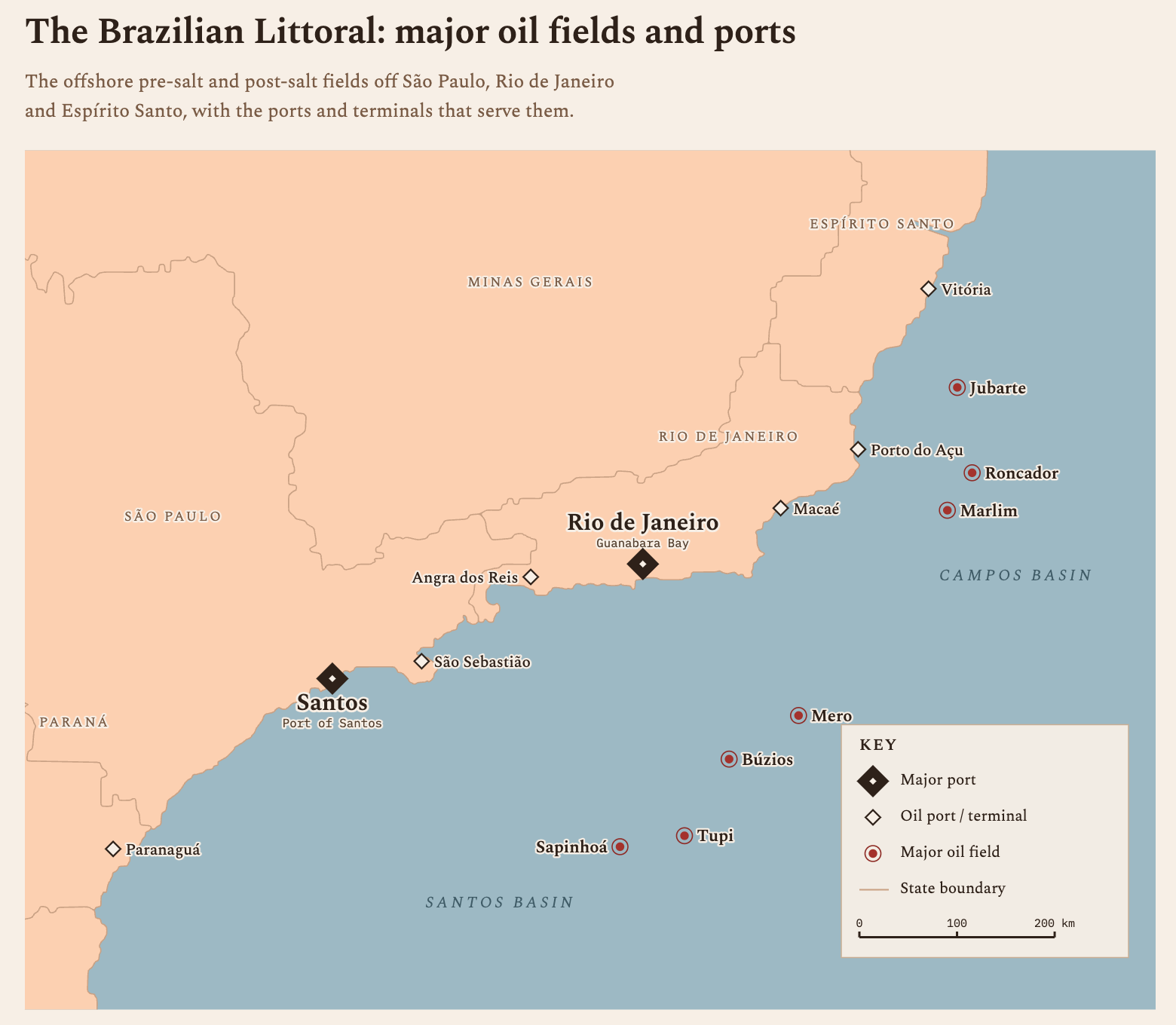
The US will not take the same sort of action in Brazil as in Venezuela; Navy SEALs will not be spiriting Lula out of Brasilia in the dead of night, but rather they will rely on Bolsonaro’s election to draw Brazil closer to the US orbit. In terms of what the US and China are competing over, we are mostly talking about commodity flow, trade, and ports, in essence the coastal regions or the littoral. One of the mega-trends of the 21st century is the movement of people, services, and goods from the rural interior to the urban littoral, creating a modern ecosystem that reacts politically, socially and criminally in new ways. The ports of Rio de Janeiro and Santos in Brazil and Maracaibo in Venezuela are these modern cities that are the political and economic lifeblood of nations, and are the places that the superpowers compete for influence in very different ways. China’s Belt and Road initiative has been the cornerstone of their imperial project. China builds and buys ports, roads, and infrastructure, on the theory that by controlling the nodes it controls the path. It also takes non-controlling equity in things like oil fields and mines, the 25% stake in the Guyanese Stabroek block being a prime example. In contrast the United States takes control of the flow in the region. The US is the guarantor of security, controlling the sea lanes; and where the Chinese buy from Petrobras, American companies hold the licences and the offtake in Venezuela. Both models have elements of coercion, from American rhetoric to the Chinese debt traps. However the recent reversal in Venezuela shows that control of the littoral ecosystem, politically and economically, is the defining factor in who wins a nation
Oil Control
The main driver behind the American use of force in Venezuela was to simultaneously open up Venezuelan oil fields for American companies, and to dump China (and Russia) out of that market. This was a strategic objective because securing regional sources of oil has become more important as the world fractures into a more multipolar system. The location of a resource has become more important as free trade becomes less free. Furthermore, by taking control of Venezuelan oil production, the US have denied China a source of cheap oil. Venezuelan oil was traded at a discount for two reasons. The first is that it’s extra heavy and sour, which means it’s hard to refine and full of impurities. The second, and more relevant for us, is that it was an encumbered asset. Encumbrance, as defined by Zoltan Pozsar, is a commodity whose trading, financing, or destination is restricted by geopolitics. Sanctions made China one of a limited number of destinations for Venezuelan oil. In financial terms, however, this allowed China to pay a discounted rate. Heavy crude generally trades at $9-10 below Brent (the global standard oil price), while Venezuelan Merey crude was trading at $14-16 below Brent. Merey delivered to Gulf Coast refineries is now at market price. Where the geopolitical haircut disadvantaged Venezuela, under the new system, production has increased, the price has improved, and there is investment being pledged to the country. However the US government stake in NABEP, and the US control of the oil revenue means that Venezuela is very much still at the mercy of a superpower. In many ways Venezuela has simply switched systems. Where Beijing’s system had claims on Venezuelan oil, it now flows to Washington.
Trade in Dollars
One of the main changes in Venezuela was their re-entry into the dollar system proper, one of the bulwarks of American power. Even under sanctions, Venezuela never truly left the dollar. From 2023 PDVSA began moving its oil sales to USDT, a dollar-pegged stablecoin, and by 2024 was demanding prepayment for half of each cargo in it. Caracas swapped American banks for a shadow dollar, which kept its revenue out of Washington’s reach but not out of the dollar. Brazil, which produces around quadruple Venezuela’s oil output, and ranks in the top seven globally as a producer, never left it. Brazil sends 54% of its oil exports to China; the next highest is India at 8%. This illustrates how important the relationship with China is to the Brazilian economy. Over 90% of Brazilian trade is denominated in dollars, and Petrobras don’t trade in yuan, so unlike in the Persian Gulf there is no challenge to the almighty dollar. China’s approach to empire building is really economic entanglement, and there is no doubt that Brazil is reliant on China as an export market. The US approach is more extractive, where China buy the resources from Brazilian companies, the United States buy equity in the producers, at least in critical minerals. Guyana is the clearest example of this model. Though there is significant Chinese equity, around 85% of Guyanese oil flows to Europe and the Americas; once again control over the flow is the important factor. This is particularly important in the case of Brazil, which is simultaneously a major trade partner with China, and a nation which holds massive reserves of critical elements. Brazil is the world’s largest producer of niobium, second largest exporter of iron ore, holds large amounts of nickel and lithium and most importantly, behind China, has the second largest reserve of rare earths. China buy a large proportion of Brazil’s mineral output, however the only rare earth producer, Serra Verde, is being bought by a US firm and is ‘renegotiating’ its contracts with Chinese buyers. This, like the capture of Venezuelan oil, is both a strategic acquisition and an exclusionary action. However, the sheer volume of trade with China means that Brazil remain outside true American control. The competition is still ongoing, which is why the US, in the run up to this election, have turned to other forms of indirect influence and coercion.
Crime and Coercion
One of the interesting aspects of the emergence of the littoral is that it has created massive security dilemmas both on national and transnational levels. The combination of resource flow, growth, and poverty has given criminal organisations power akin to non state actors. One of the major advantages the US has over China in the competition for the Latin littoral is its ability to project political pressure, and dispense political capital. In May Flávio Bolsonaro visited Washington, and within days the US designated the two largest Brazilian criminal enterprises, the PCC and the CV, as foreign terrorist organisations. This has two major implications. First, it acts as an indirect endorsement of Bolsonaro (he claimed credit), and secondly it fits into a broader US regional anti-cartel strategy which has operated as a way to project and use force outside of wartime. Crucially Bolsonaro has not rebuffed China, merely signalled that he would shift politically and security-wise towards the American position. In terms of geopolitics this is the main implication of the Brazilian election. The Chinese and American imperial competition is staying below the threshold of overt conflict in Latin America, remaining a battle between Chinese investment and American influence.
Geo-Monetary Competition
The competition between China and America is playing out mostly in an economic sphere, but regional hegemony matters a great deal, not only in terms of security but also to control commodity flow in their respective geopolitical backyards. One of the recent developments is the re-emergence of the importance of inside and outside money. Inside money can be frozen or sanctioned, dollars for example. Outside money, however, can’t be, like gold, bitcoin, or most relevant for this article, Venezuela using barrels of oil as debt repayment to China while under sanction. Commodity flow in our opinion has become a form of outside money, at least in terms of one system. This lines up with Pozsar’s explanation of Bretton Woods III. Bretton Woods I being the pegging of the dollar to the price of gold, then II being floating fiat currencies backed by reserves held in dollars, and now III where geo-monetary dynamics mean that outside money will be what backs value. The trigger for Bretton Woods III was when the G7 froze Russia’s foreign exchange reserves and the idea of how vulnerable inside money was crystallised. The critical aspect here is that Brazil bought 43 tonnes of gold in 2025, outside money; given how much of their trade is in dollars this is part of their hedge to remain part of both systems. However the imperial competition means that hedging can only go so far. Gold will protect Brazil’s reserves and even offer a mild bulwark against American economic colonialism, but it does nothing to secure trade. It is the physical flow of commodities across the ocean that things like the Houthis and Iran are impacting. Amid the Hormuz disruption, beyond raising the price of oil, the cost of shipping oil from Jose to the Gulf Coast refineries has risen from $1.90 to $5. Geopolitical developments 8,000 miles away have created a situation where even though the US control the source, the route and the destination of the oil, the shipping cost has still jumped $3. However, the importance of geographic origin means that the cost to ship Brazilian oil to China is even higher. So even though China bought a record amount of oil from Brazil after the Iran War broke out, the route is long and exposed, raising the cost to China. Every disruption makes the American route cheaper relative to the Chinese one. Controlling the commodity flow is even more important these days; it is the only way to keep nations within a system or draw them in.
Conclusion
The Brazilian election is a choice between systems: Lula’s strategic autonomy and Flávio Bolsonaro’s security links to the Trump administration. Lula has openly resisted the American push for regional dominance, which Bolsonaro has derided as ‘licking China’s boots and throwing stones at the United States’. Bolsonaro would bring Brazil into the American security orbit, and reassess the relationship with China. For a Brazil whose credibility has been eroded over the last few years the precariousness of their position means it will likely have to pick a side. And that side will have a domino effect: either China’s economic entrenchment in Latin America will strengthen, or the continent will fall to the Donroe Doctrine. Whoever wins on the 25th decides who Brazil’s barrels and minerals will fall to, and which geo-monetary system will take the advantage in Latin America. History, geography and the polls all say that Washington should take this one.