
In early October, at half past one in the morning, a Ukrainian FP-1 drone flying low over the Ryazan countryside was approaching the old Sasta foundry at full speed. The resulting impact took out two Russian supercomputers and seriously damaged one of Russia’s largest data centres. This was a salvo in the new Ukrainian war, far from the conscripts shivering in the treelines of Kostyantynivka; a war targeting infrastructure instead of soldiers. After four and a half years of fighting the frontlines of the Ukrainian war are deadlocked, with gains of metres being paid for in hundreds of lives.
Schelling & Punishment
A decisive military victory, barring an unexpected capitulation must seem out of reach to both the Russian and Ukrainian high commands. Historically military victory has been the deciding factor in most conflicts, punishment and pain in the form of attacking civilians has not. However in the absence of a path to military victory it becomes the main process of bargaining. This is the ‘diplomacy of violence’ as laid out by Thomas Schelling in Arms and Influence, and it is to this strategy that Russia, and to a lesser extent Ukraine, have turned in an effort to compel surrender. Russia’s strategy is in essence to bombard the Ukrainian populace into submission, through indiscriminate strikes on civilian and economic targets. Russia’s strikes also damage Ukraine’s military capabilities but this is an ancillary benefit. The objective is to cause Ukraine such economic and political pain that it will concede to maximalist demands. Ukraine’s strategy is to target Russia’s influence in the global economy by taking away their capacity as an exporter, first of energy and then of disinformation; the punishment inflicted on the Russian people a secondary concern. Both strategies are using ‘the power to hurt’ as a coercive tool, with scope for escalation as the key aspect.
Russian Targets
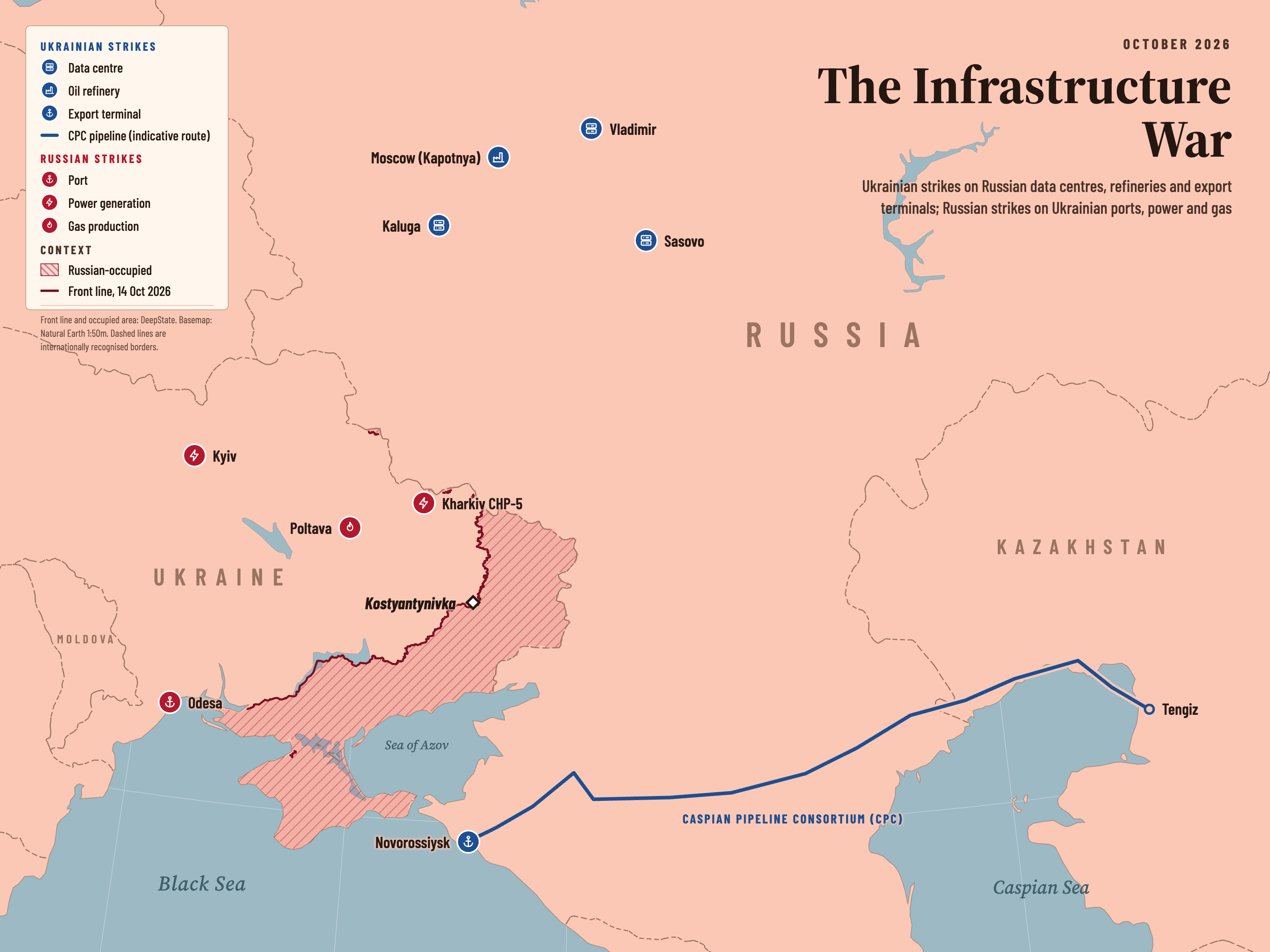
Russian strikes on Ukraine rely on the fear of escalation; Russian missiles and drones take out both Ukrainian power plants and gas production. The goal is to deny hospitals and schools power, to demonstrate ‘the capacity to hurt’ that puts social and political pressure on President Zelenskyy. Last week there were 200+ individual strikes on energy assets, on the 1st of October there were 190 Russian drones and missiles launched in 24 hours. This is high operational tempo but with Russia’s ever increasing capacity to replenish their drone and missile stockpiles it has room to increase. With an El Niño winter looming this is particularly ominous information for those defending Ukraine. The other, equally important, Russian target is Odesa and the Ukrainian grain industry; Odesa alone handles 90% of Ukrainian grain exports. By hitting grain ships and port equipment the Russians are effectively denying Ukraine their largest export, agriculture comprising over half of Ukraine’s export revenue. Workarounds, as have been found for oil in the Strait of Hormuz, are not plausible due to record low water levels in the Danube river and the general inefficacy of road transport. Projections have agricultural exports falling 54% in 2026-27 which is catastrophic for a country already in a spectacular amount of debt (around 60% of GDP after factoring in debt likely to be forgiven). There are multiple reasons why the Ukrainian grain industry is a strategic target beyond pure financial damage. Ukraine’s importance to the global food industry creates diplomatic and humanitarian pressure to end the war and, by driving up the price of commodities like wheat and corn, the strikes boost the value of Russian agricultural exports, offsetting losses in other sectors. Russia is trying to cripple Ukraine both internally and externally. The critical thing to remember about these Russian strikes is that they are a form of bargaining, a perverse form of negotiations.
Ukrainian Targets
As with all negotiations, drone strike diplomacy is a two-way street. Ukraine, like Russia, targets energy infrastructure but with different strategic intentions. The primary targets are Russian refineries rather than crude production facilities or power plants, and these strikes have been very successful. Russian refining capacity is at its lowest ebb since 2002, the Moscow Kapotnya refinery which provides 40% of that regions petroleum products was taken offline in late September. Targeting domestic consumption is less about civilian damage however, and more likely an attempt to foment unrest and undermine the security and prosperity reputation of Putin. Energy strikes have been going on for a while, however in recent months Ukrainian targeting has narrowed to focus on secondary cracking facilities, specifically the ones that impact diesel production. Hitting Russia’s diesel production hurts both their export revenues and their ability to influence global politics. In peacetime Russia is the second largest diesel exporter, responsible for around 10% of seaborne diesel trade which not only brings in a large amount of foreign reserves in revenue, but also gives Russia the weaponised ability to impact a critical industry. For example when Russia banned the export of diesel, the diesel benchmark price jumped 11.6%. The success of Ukraine’s attacks on the Russian diesel industry can be seen in the July diesel export ban and the fact that Russia, once described as ‘a gas station with nukes’ was reduced to importing refined products from India and Belarus. This success however comes with a caveat; Russia’s importance as a provider of energy molecules creates turbulence in the energy markets which can blow back on Ukraine.
The Caspian Problem
American demands for Ukrainian restraint crystallised after Ukrainian strikes on the Caspian Pipeline Consortium (CPC). The CPC is a pipeline running from the Tengiz oil field in Kazakhstan to Novorossiysk on the Black Sea coast, it carries 80% of Kazakhstan’s oil exports but is jointly owned by the Russian State (31%), Kazakhstan (20%), Chevron (15%), as well as Lukoil, ExxonMobil, Shell and others. A Russian dominated, but thoroughly international, project; Russian oil makes up 15% of the throughput and because of this it has been targeted by the Ukrainians since 2025. The problem with this is that the impact on Russian exports is marginal, it represents about 2% of Russian oil production, it has a far greater impact on Kazakhstan and the western companies heavily invested there; Chevron’s partnership, Tengizchevroil, for example. Strikes on the CPC also remove barrels from an oil market that is already extremely tight. So in the aftermath of Ukrainian strikes in July 2026 which hit an Exxon ship loading Kazakh oil the US brokered a deal to limit what Ukraine was allowed to hit. The deal protected CPC infrastructure and vessels with no links to Russia. The limited amount of Russian throughput and the fact that it is a single target means that strikes on the CPC are unlikely to shift the calculus of the Ukraine war for either Russia or Ukraine. However the precedent set and the geopolitical sensitivity to the oil market have led to the current Ukrainian problem.
Compellence by Diesel
The twin problems now facing Ukraine are the erosion of American support due to energy prices and the American energy deals with Russia. This has not happened just because of Ukraine’s success in striking Russian refining capacity, but rather it is the easiest place for the Trump administration to apply pressure to move energy prices. The Iran war has had a far greater impact on prices, but with the midterms approaching there is a political expediency in mitigating the tightness in the markets. The deal is 300k tons immediately, 500k in November, then 1m ‘immediately thereafter’ and finally 3m based on the condition of Russian diesel refineries. The last sentence is the key clause as the deal then hinges on Ukrainian restraint. The thing is, these volumes are actually pretty small, 300k tons of diesel amounts to 18 hours of American demand; it will still move prices more than some are predicting but it wont be much. However, it sends a message politically to Trump’s base and shifts the onus for energy prices from Trump’s forever war in Iran to President Zelenskyy. This is perhaps best illustrated by Trump’s announcement of an ‘energy ceasefire’ on Sunday. Ukraine originally signalled compliance with it and Russian drones hit a power plant in Kharkiv. The truce lasted 3 days; Ukraine resumed their attacks on the morning of the 15th. Trump’s attempts to broker a ceasefire exist solely to stop Ukrainian strikes, as the destruction of the Kyivan grid won’t move the price of diesel in Ohio.
Hostages and Inside money
In Schelling’s framework a hostage is something your adversary values that you place at risk to coerce action (or inaction). The major problem is that perhaps the most effective Ukrainian hostage has been removed by American entanglement with Russian refining. It has turned a target into a strategic weakness for Ukraine and aligns the US with Russia more than ever before. It presents a dilemma for Ukrainian planners to either show restraint and adhere to a one-sided truce, or to continue with the energy strike strategy and risk the loss of American intelligence support. So far Ukraine are calling the American bluff and are tentatively continuing their campaign, at a reduced operational tempo. It isn’t just political timing that has pushed the Americans to these rather extreme actions, it is also the same weakness being exposed by the Iran War, the weakness of inside money. The source of American leverage in the form of sanctions which only works when the world needs dollars more than it needs diesel. Tightness in the energy molecule market often leads to sanctions relief of one form or another as you can print dollars, but you can’t print diesel. Russian commodities suddenly lose their geopolitical encumbrance and suddenly there are strategic complications for Ukraine. Simply put the Russians are trying to replace an aging air defence system with diktats from Washington DC.
Russia’s Other Export
Even during the three day energy pause Ukraine never stopped responding to Russian attacks in kind. Data centres and computing lie outside of the energy truce, and crucially don’t move any form of global price. In the past week Ukraine have targeted Yandex, the Russian Google. Hitting Sasovo, Kaluga and Vladimir within four days of each other. Yandex only run 5 data centres and 3 of them have been severely damaged. While this doesn’t cripple Russia’s cloud computing, they can prioritise workloads and shift computing, it does create prolonged outages for Russian connectivity. This however is not a move to ‘punishment’ by inconveniencing the civilian population, rather it has two impacts. The obvious damage to the Russian AI industry is one, but the latter is that it damages Russia’s second most notorious export after energy, misinformation. Russian bot activity plummeted on Yandex’s servers in the aftermath of each of these attacks; the Ukrainians are targeting the troll farms. Much as the midterms have impacted American strategic thinking, it stands to reason that Ukraine would benefit from a weakening of the propaganda that blames them for starting the war and for soaring energy prices. There has been a noticeable impact on next year’s French election as well where populist takes on X had comparatively few impressions and engagements. This is perhaps a harbinger of where war will go in the coming years. The global battleground, on one hand you have Russia reversing the US position through economic manipulation, and on the other you have Ukraine targeting Russia’s influence in western democracies. Populist defeats in the US this November and France in 2027 could have as much of an impact on the outcome of the Ukraine war as the failure of sanctions.
No Russian
In fact it is hard to overstate how important the US midterms will be in determining the outcome of this war. Without Russian influence there is likely to be a calming of populist discourse that can only hurt Trump’s chances in stoking outrage or creating an ‘October surprise’. The energy market is unlikely to loosen in the short to medium term as any disengagement in Iran will take time, particularly now that the Houthis are an issue for Saudi Arabia. So it’s plausible that no matter the result the Russian sanctions relief will remain regardless as it’s a structural failing rather than just political manoeuvring. The signal to watch to see just how vulnerable Washington is to Russia is the distillate crack spread, if and when it eases Washington will be able to take the leash off Kyiv. Where the midterms will have an impact is in terms of material support for Ukraine, and where the pressure falls. It is doubtful a lame duck Trump presidency will have the capacity to truly lean on the Ukrainians to not hit Russia’s refining capacity, but there could be a spiteful denial of cooperation from the Department of War. This is the other signal, American intelligence sharing with Ukraine will indicate the stance of the administration, the less they share, the more vulnerable to Russia they truly are. However even a complete Republican defeat in the Midterms, ie Senate and House, will not in the short term offer too much relief to the Ukrainians, it will take time to pass bills and undo the damage wrought by the Trump administration. This winter then is still maximum danger for Ukraine.
Conclusion
Russia are winning these negotiations by drone strike, in a contest of who can cause the most pain Ukraine are doomed to failure. Both sides are bargaining by targeting; Russia hurting Ukraine directly, plunging its cities into darkness and choking its ports, Ukraine hitting Russia on the global stage. These are both strategies designed to coerce a change in condition that will allow them to dictate terms at any peace summit. However the importance of Russia to energy markets and the ever clearer weakness of inside money has seen Washington blink, at Ukraine’s expense. Even the strikes on data centres aren’t enough to compensate for the protection of Russia’s energy assets. This sanctions relief will continue as long as the energy market remains tight, and that will be Ukraine’s problem. The limitation of inside money means that Russia have the US over a barrel, and the US, because of their intelligence and Ukraine’s military reliance, have them over a barrel. So any pressure to de-escalate will be put on Kyiv not Moscow. With winter coming, Russian power appears to be resurgent, but November and beyond will see many more FP-1s flying at full speed across Ryazan; targeting data centres and diesel refineries alike.