
Introduction
‘The horrors were repeated, with minimal variations, inspired by profit’ writes Mario Vargas Llosa of the Congo in his novel The Dream of the Celt. For a story set in the late 19th century it bears a remarkable resemblance to the geopolitical experience of the DRC in the modern day. A nation ravaged by civil war, insurgency, and business practices Leopold II might have been proud of. A nation currently engaged in its own forever war, but one that bears little resemblance to the American misadventures in the Middle East. Conflict has become endemic to the region like a disease. There has been nigh on continuous fighting in the DRC since 1996, when the AFDL, backed and directed by Rwanda, marched to Kinshasa and placed Laurent Kabila in power removing Mobutu Sese-Seko; and even now there are well over 100 armed groups of one sort or another operating in its sovereign territory. Pre-eminent among them is M23, a paramilitary group backed by Rwanda operating in the Kivus.
M23 History
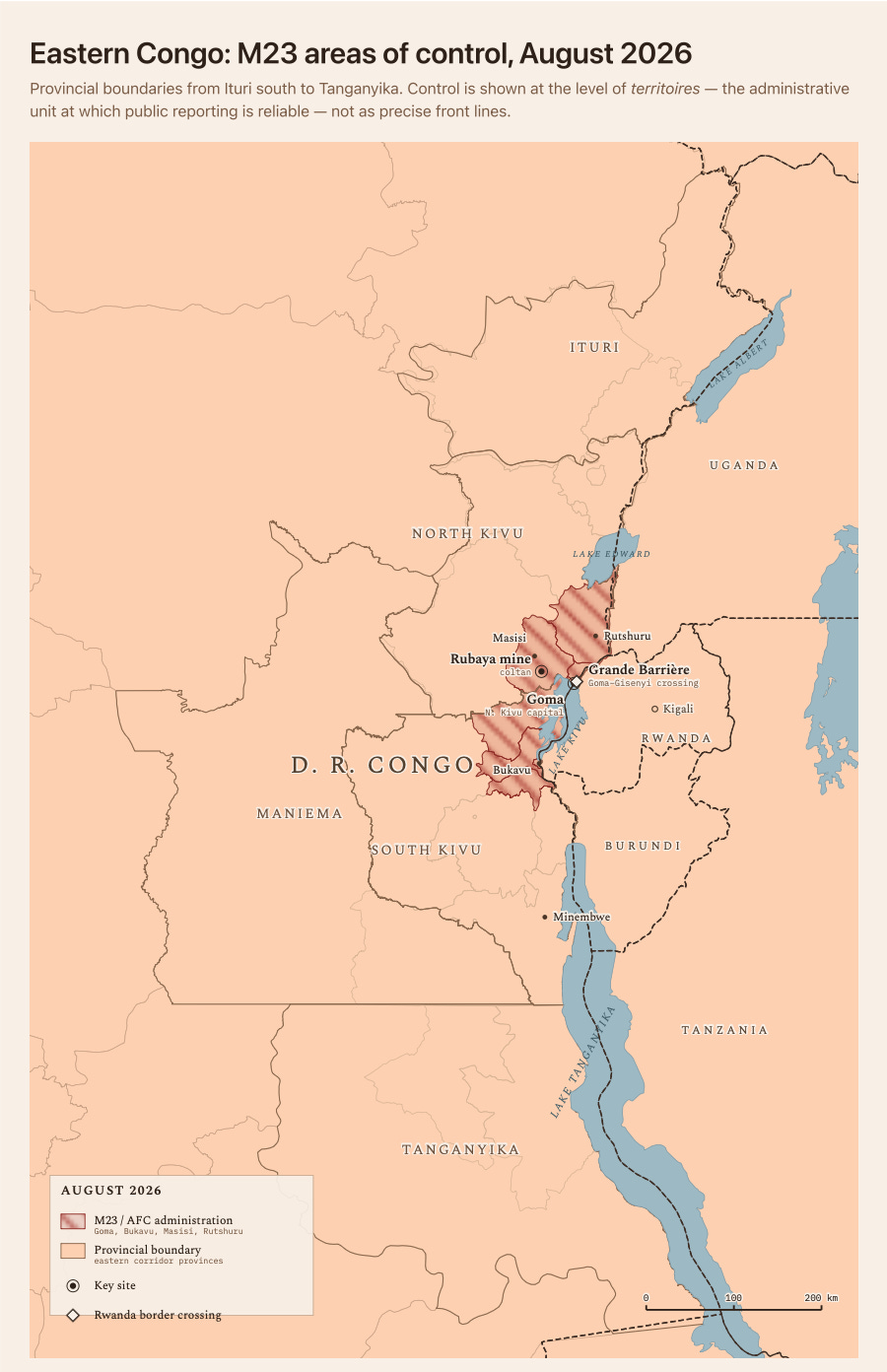
Formed in 2012 by mutinous FARDC (Congolese Army) troops who had once been part of the CNDP (Rwandan backed rebels) until welcomed into the Congolese army as a unification measure. M23 took over Goma, the capital of North Kivu for 10 days, before retreating and ultimately surrendering to a Congo-UN joint force. This was mostly due to an internal split within M23 leadership rather than due to any great military success by the FARDC or MONUSCO. In 2021 M23 reemerged as Sultani Makenga consolidated support around him and gathered together disparate factions. Over the last year M23 manpower rose 5,000 in January 2025 to 27,000 by December. M23 claims to have taken 34,000 km², including large parts of North Kivu and some of South Kivu. They are, in a word, a fully fledged insurgency. Their stated aims are the implementation of past agreements, protection of Kinyarwanda-speaking Congolese, and FDLR neutralisation. In reality they were backed, armed and financed by Kigali from the very start. During the Goma offensive there were around 4-7,000 RDF (Rwandan Defence Forces) troops fighting alongside the M23 soldiers. Critically the FARDC had 2000 troops surrender at the end of that battle. The RDF and M23 are a much more effective military force for one precise reason. Rwanda’s forces are designed to fight, DRC forces are designed to prevent coups.
Greed and Grievance
Though they are not an army, their effectiveness can’t be denied. In truth M23 lies somewhere between a proxy force for Rwanda and a business enterprise. The proxy force aspect comes from the ethnic and security interests that Rwanda holds in Eastern Congo, as well as historical grievances between DRC and Rwanda. Whereas the business aspect, which we classify as greed, comes out of the economic extraction of Congolese mineral wealth to enrich Rwanda and fund M23. The Kivus contain vast supplies of Coltan and other critical minerals, and sit on the border with Rwanda. Greed and Grievance is a concept created by Collier and Hoeffler, and it is an important part of modern insurgency theory. The security question involves the FDLR, one of the last remaining Hutu rebel groups opposing Paul Kagame’s Tutsi dominated regime. This is a very real concern, and denying the FDLR operational space is crucial to Rwanda’s internal stability. These ethnic tensions are the grievance upon which M23 was founded, and are an important part of the current insurgency. As for the financial benefits, Global Witness estimates that there is a $7 per kg tax on coltan being exported from the Kivus, split with $4 to M23 and $3 to Rwanda. This is a symptom of an entrenched insurgency. M23 are creating a functional governance system in Goma. Not only with taxation but by providing justice, structure and services, including reinstating Congolese police officers and administrators. This is a classic insurgency strategy that delegitimises the official government and bolsters both recruitment and acquiescence among the local population, and it makes M23 seem less like a rebel group and more like a government in its own right. There are even reports that the efficiency and security of the Rubaya coltan mine has actually increased since the M23 takeover. M23 are not mindlessly opposing the DRC. They are cannibalising whole regions, and using the vast mineral wealth of what they take to create a de facto rebel state. One that, due to its position and its strength, can impact markets oceans away.
Copper, Cobalt, and Tantalum
The DRC is without question one of the most mineral rich countries in the world, in particular when it comes to copper, cobalt, and tantalum. It is the second largest copper producer on the planet after Chile, and produces 80% of global cobalt, and of the 19 major cobalt mines, 15 are at least partly owned by Chinese companies. Notably CMOC owns 80% of the Tenke Fungurume mine, and 75% of Kisanfu, then there is the CNMC and Gécamines joint project of Deziwa, and finally Kamoa-Kakula which is a joint venture between Zijin (39.6%) Ivanhoe (39.6%) and the DRC state (20%). While M23 are 1000 miles away from the copper and cobalt producing regions, it matters because it aligns China very strongly with Kinshasa. There is a strong historical partnership between China and the DRC, one that, as a result of low US credibility in the region following the second Congo War, and western underinvestment has given the Chinese a huge advantage in controlling the global supplies of copper and cobalt. The final major Congolese export is tantalum. 40% of the global supply comes out of the DRC; the Rubaya mine alone produces half of the DRC’s tantalum. Furthermore 18% globally comes from Rwanda and Burundi, meaning that the region as a whole produces 58% of the total supply. Tantalum is one of the most important critical minerals on the planet, in particular tantalum capacitors, which are near irreplaceable in data centres. Which leads us to the surreal fact that a rebel group is heavily levered to the AI Capex cycle.
The Chinese Hedge
You might expect, given China’s strong relationship with the DRC, that they might exert diplomatic pressure or impose financial sanctions on Rwanda and M23. However while China may own much of the Congolese industrial base, they are also Rwanda’s largest buyer of tantalite. This is the Chinese hedge, where they are engaged in trade with both sides of this pseudo civil war. Furthermore, CNMC bought Mineração Taboca in Brazil in November 2024 to secure tantalum access outside of the region, insuring themselves against the M23 conflict. The ongoing AI arms race with the United States has made access to these minerals so important, that realpolitik is the default mode of all major powers involved. Beijing has no incentive to alter the status quo in this conflict and disrupt their supplies of minerals during this critical period. They, like others, tolerate Rwanda’s support of M23 because they need Rwanda.
Rwandan Mineral-washing
Rwanda’s role in this conflict as patron and partner is long-held and strategically crucial for Kigali. Their economic interests, both in terms of exports and further afield are well served by the M23 insurgency. In particular the manner in which Kivu coltan can become Rwandan coltan with very minimal effort. Kivu ore crosses the border from M23 held territory past Rwandan customs and is then mixed with Rwandan ore. It is all then marked as conflict free and enters the legitimate market in a process known as mineral-washing. M23’s early campaign, as they closed in on the mining region forced Congolese state agents to withdraw, meaning that there is no way to verify the provenance of Congolese coltan. The trucks filled with ore rumbling through the Grande Barrière however might offer an idea. This mineral-washing is indicated by spikes in Rwandan exports that are not readily explainable. For example after M23 took Rubaya, the next quarter Rwandan coltan exports jumped by 42%. The economic benefit to Rwanda is that in 2021 their mineral exports were $507.6m and by 2024 they were $1.75b. The benefit of M23 is that not only does it enrich its patrons, but as a force it destabilises and weakens a regional rival.
The Condottieri State
The impact M23 has on Rwandan regional power cannot be overstated; by fighting the FDLR as well as having a negative impact on the DRC’s political stability and economy, Kigali can remain the pre-eminent power, both economically and militarily in the region. Even while being one of the smallest countries on the continent. On the back of this Rwanda has made itself indispensable to both the region and to its great power patrons as well. Rwandan troops consistently form the backbone of UN peacekeeping missions in Africa, as well as any African Union coalition forces. Rwandan forces also operate in neighbouring countries as auxiliaries, notably in Cabo Delgado in Mozambique. Cabo Delgado is an LNG producing region run by TotalEnergies. There is a local insurgency of IS-Mozambique, which, similar to M23 uses grievance and greed to recruit and remain endemic within the region. In this case greed and grievance are the same thing, exclusion from the LNG profits. In 2019 the Mozambican government recruited Wagner Group mercenaries to restore order, they failed publicly. Some of them were even beheaded and they withdrew within months. Subsequently in 2021 Rwandan forces deployed to a current force level of 5000 troops and have enabled the ending of force majeure. Rwanda’s strength as a small nation is born of its elite military capacity, they are a ‘Condottieri’ state in the vein of the old Swiss Confederation. A small poor mountainous state which sold its elite military to the great powers of its day, the Spanish Empire, the Papacy and France. And in this way they guarantee their own survival. This is the playbook Rwanda are reading from. On their own they would be incapable of fighting larger wars, but by acting as elite auxiliaries and thereby creating a network of patronage they are able to be regionally dominant. Chapter 13 of the Prince is clear on the perils of loaning forces from another state: if you lose you are destroyed, if you win you are beholden to another power. However the inversion is desirable, if they lose your state survives, but if they win you have another state as your prisoner. Machiavelli’s warning was addressed to Princes who borrow, Paul Kagame has made sure he is the Prince who lends.
Tolerance
Rwanda’s status as a Condottieri state is one of the reasons that its murky relationship with M23 is allowed to prosper. Prior to the deployment of Rwandan troops to Cabo Delgado TotalEnergies declared force majeure but as of January 2026 that has been lifted. This has two effects: it removes the greatest source of instability for the Mozambican financial system, and guarantees profits for TotalEnergies. This is a replicable system, and as the conflict in the gulf sends the search for molecules into new places, perhaps one that will be needed again. It is the alignment with western interests and their willingness to use force that places them as a necessary ally. Their stability in a region beset by conflict means it is not worth creating a pariah state. But it is not only that auxiliary nature that allows Rwanda to operate a proxy force with minimal repercussions. Economically China and the EU both buy large amounts of coltan from Rwanda. The EU even signed a critical raw materials partnership in the weeks before Rubaya fell to M23. All eight smelters sourcing Rwandan coltan were audited under RMAP in 2024-25, and all eight passed. This tells us that the compliance architecture is designed to allow Rwanda to wash the coltan rather than to catch them. The economic benefits that the west get from the Rwandan proxy force and smuggled coltan outweigh the downsides of tacitly accepting M23’s primacy over North Kivu. The entrance of the United States into this dispute in 2024 reflects not only the critical nature of control over these metals, but also the new transactional nature of the American government under President Trump. The US have cut M23 out of the negotiations, and is focusing on the relationship between Kigali and Kinshasa. Washington is treating this as a Rwandan war rather than an insurgency.
Trumpian Diplomacy
The American diplomatic efforts have two main ambitions. The first is to secure the supply of tantalum for their own uses, with a peace for minerals deal wherein the United States will be the guarantor of peace in exchange for buying the coltan produced. The second is to weaken the stranglehold that China have on the copper and cobalt production in the Congo by building better relationships with the DRC. Such is the confidence in these talks, President Tshisekedi is marketing the Rubaya mine (under M23 control) to investors, most notably America First Global. Tshisekedi is also bartering with America in an attempt to sway them to his side. Three American nationals involved in the 2024 coup attempt were released days before Trump’s negotiators arrived. This combination of human currency and peace for access is characteristic of American policy recently. However any deal between Rwanda and Congo that doesn’t resolve the two major issues, namely M23 which is on a separate diplomatic track mediated by Qatar, and the ethnic grievances, will lead inexorably back to conflict and further disruption. The US peace plan would require a degree of commitment and attention that African files simply have not received from the state department historically. Furthermore the entrenchment of M23 and their creation of a parallel state within the Kivus means that Rwandan passivity would be a blow but not fatal. And while US pressure has rolled M23 back from Walikale and Uvira, these are two minor concessions after three years of negotiations. Selling access to these minerals is Tshisekedi’s best chance of staying in power, however he has lost control of them.
Coup-proofing by proxy
The recent history of the DRC has been defined by coups and coup attempts. On the 19th of May 2024 Christian Malanga launched a failed coup and died in the attempt, and in the last year 30 Generals, disproportionately Kinyarwanda (Rwandan) speaking Easterners have been detained and charged with treason. Historically Mobutu kept the army weak and fragmented to prevent threats as that is generally where the majority of coups emerge. The problem with this was that in the First Congo War the Rwandan army was able to sweep past them to Kinshasa. However this is not without precedent, rulers facing coup risk exclude rivals from the centre and trade a coup threat for a civil war threat, as put forward by Philip Roessler in Ethnic Politics and State Power in Africa. That is perhaps an effect of this conflict for Tshisekedi, the army is occupied and 1000 miles from the presidential palace. Though as Mobutu’s example demonstrates, coup proofing works well until a weakened army has to fight. Which is precisely why 2000 FARDC troops surrendered so meekly to the RDF-M23 force at Goma. However M23’s ambitions seem to be focused on consolidating control in the Kivus rather than dragging Tshisekedi from the presidential palace. Whether or not this is a choice, this is an ancillary benefit for Tshisekedi. The war may be destroying the DRC but it is bolstering his legitimacy.
Conclusion
This war has gone under the radar, and perhaps it is supposed to. M23 are governing more effectively than the DRC ever did. Tantalum is making it out of the region and into AI chips via Rwanda. Both the US and China’s copper and cobalt interests are being protected and Felix Tshisekedi’s government is more coup-proof than ever. And the Rwandan Condottieri state is free to protect western interests across the continent. The war is in a profitable equilibrium, with the only ones suffering the Congolese people. Though as we have seen, that equilibrium survives only as long as it is profitable for everyone. ‘The horrors were repeated’, and while the Force Publique may have been replaced by mining companies and auditors, Congo remains as much at the mercy of great powers as it was at the turn of the century.
I'm congolese and this is the most elobrative article ever written on the geopolitics of the current great lakes regional wars on Congo. Two questions;where can I find more of these information & sources you've pulled as well as what do you think of recent Israel partnership & the DRC?
Very interesting piece. President Tshisekedi’s “minerals for security” approach, inviting Western investors to break the Chinese coltan and cobalt monopoly while simultaneously pushing for copper and cobalt to be smelted on Congolese soil is good for investment but the humanitarian situation for millions remains devastating especially with the new Ebola epidemic.